
Gen Z's Digital Autonomy
Investigating how social media platform design impacts autonomy in Gen Z users and translating research insights into design opportunities that support intentional use.

Problem
Social media platforms prioritize engagement over user well-being, often exploiting emotional triggers to keep users scrolling.
This causes reduced autonomy, attention fatigue and compulsive usage patterns.
Which has a significant impact on Gen Z users, who spend the most time on these platforms.
Research Questions
- How do Gen Z users experience autonomy while using social media?
- What situations lead to intentional versus compulsive engagement?
- How might we design solutions that promote user autonomy?
Overview
Modern social media platforms like TikTok, Instagram, and YouTube use algorithms that prioritize engagement over user well-being, often exploiting emotional triggers to keep users scrolling. This can lead to compulsive usage patterns, particularly for Gen Z, who spend the most time on these platforms.
Our team studied how Gen Z experiences autonomy on social media, what conditions lead to intentional versus compulsive engagement, and how design might support autonomy without feeling restrictive or punitive.
My Contribution
- Conducted 2 diary studies and 2 semi-structured interviews with Gen Z participants
- Diary studies: myself + a video director for a major league team
- Interviews: UW geosciences student + UW student-athlete
- Synthesized findings into a core framing: autonomy as alignment between intent and content
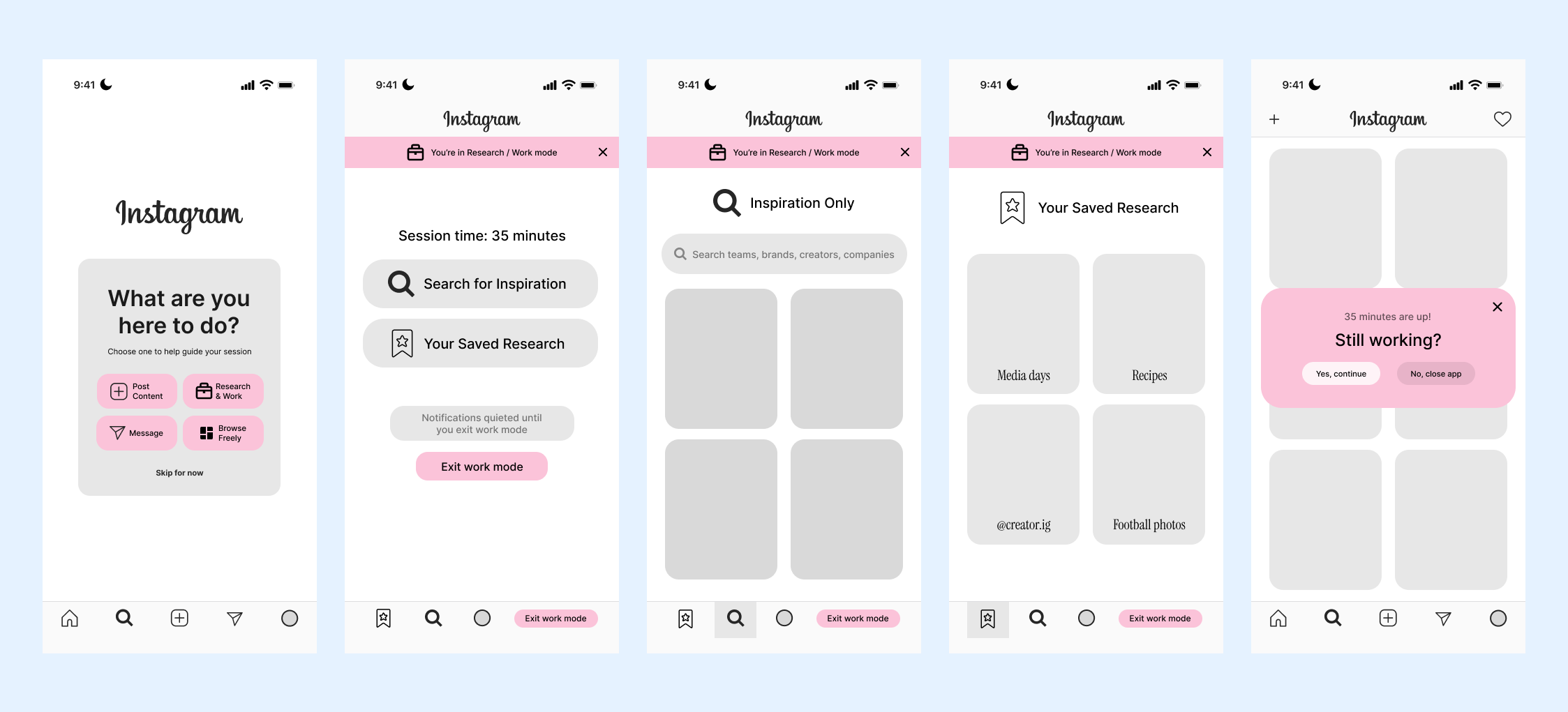
- Designed the Intent Mode wireframes to translate insights into an interface concept
Methodology
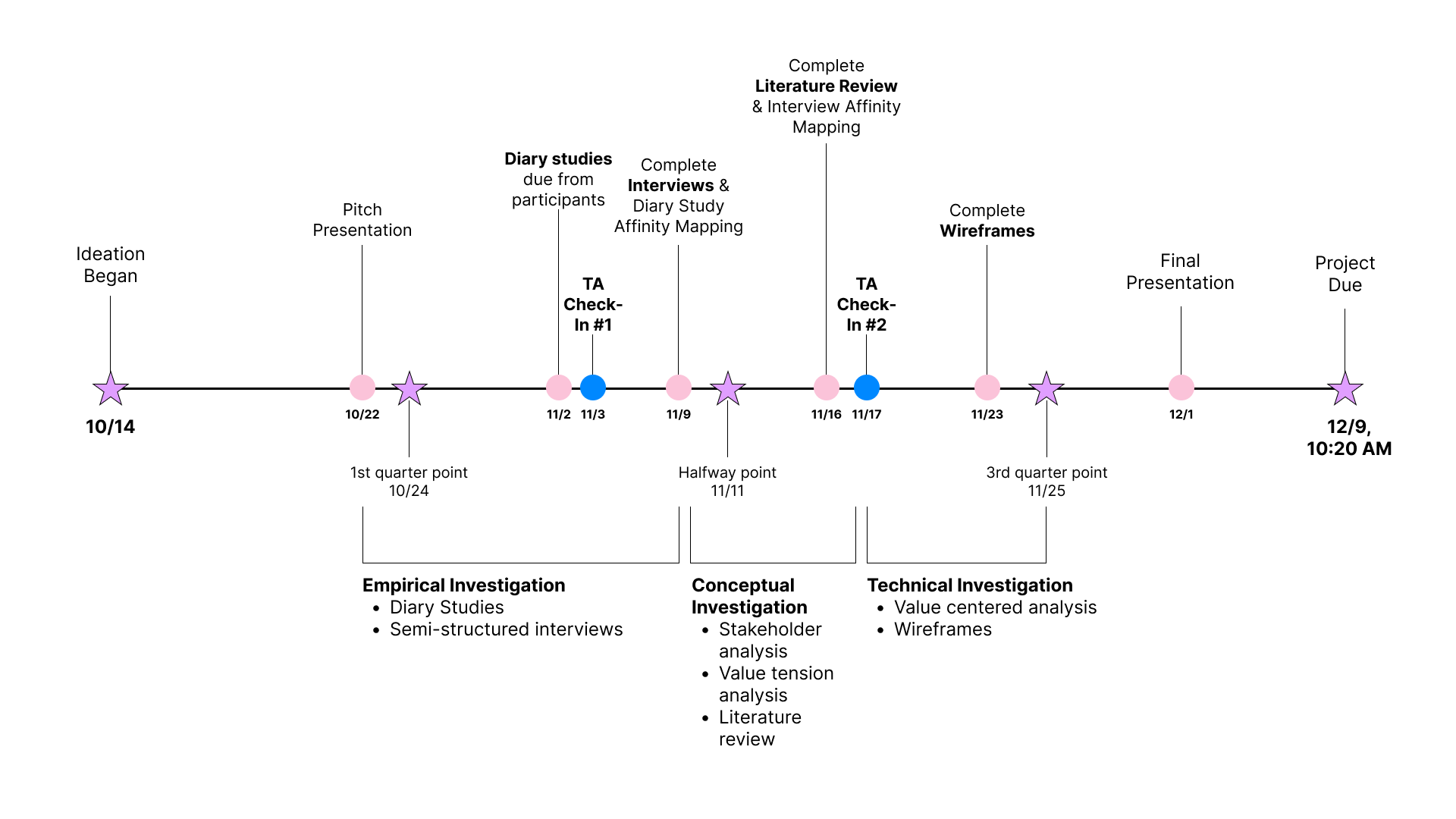
We used a Tripartite Methodology across empirical, conceptual, and technical phases combining lived experience research with values-focused analysis and design exploration.
Empirical
- Diary Study (n=10)
- Semi-Structured Interviews (n=6)
Conceptual
- Stakeholder Analysis
- Value Tension Analysis
- Literature Review
Technical
- Value-centered platform critique
- Wireframes
Key Findings
Diary Studys & Interviews
Self-moderation
People tended to ignore their own attempts at self-moderation with screen time timers.
Loss of Control
Users found that they ended up scrolling for longer than anticipated. Began intentional but turned compulsive.
Habitual Usage
Users had established routines, whether it was scrolling in the morning or at night and having a chosen app rotation.
App Design
Users recognized that the design of social media, specifically short, recommended content, often did a good job of hooking them in.
Literature Review
Self Estimation Bias
People underestimate passive scrolling and overestimate productive use.
Down Moments
Research shows that digital life has made boredom and silence uncomfortable. Any time there is a lull, we reach for our phones, wanting a dopamine boost.
Overload
Information overload leads to emotional instability and anxiety because people don't know how to process it all.
Design Framing & Concept: Intent Mode
⚠️ Our team explored several design directions in parallel. While we collaborated closely and shared research, each of us developed and iterated on our own concepts based on the insights we found most meaningful. My primary focus was on the Intent Mode experience shown below.
Our synthesis led to a key reframing:
Autonomy ≠ usage level. It's about intent and content.
Several participants relied on social media for work, identity, or responsibilities, which made time an inaccurate measurement for autonomy. The real issue begins when the platform pulls them away from their original intent.
Research quotes that shaped my direction
“I'm using these apps for "research"... but I'll come across my peers' content and sometimes get distracted... and start scrolling.” — Video director (Diary Study)
“I wish that there was an easier way to set screen time limits, that worked with you instead of setting exact times.” — Student athlete (Interview)
Features
- Mode selection asks why you're here (e.g., Research/Work, Inspiration, Social)
- UI adapts to keep you aligned: simplified interfaces, relevant explore content, quick access to saved research
- Reduced triggers: de-emphasizes notifications that cause compulsive checking
- Not restrictive: users can exit, switch, or ignore modes at any time
Takeaways
- Autonomy is supported when users can declare intent and reflect on content not just time.
- Transparency builds self-awareness and reduces reliance on blunt timers.
- Design should create natural “return to purpose” moments rather than punish usage.
- Wellbeing features need to feel like they work with you, not police you.
Future Work
- Usability test the wireframes with Gen Z users and iterate based on feedback.
- Adopt algorithm sensitivity & content visualization features into existing social media platforms.
- Refine concepts into a more cohesive hi-fi prototype direction to eventually design a new social media platform that respects autonomy and attention.